7 Voice Typing Apps for Privacy and Productivity

You move between a desktop editor, a browser, a phone, and maybe a terminal, and each one handles dictation differently. A tool that transcribes well but can't insert text into the app you are in, keeps mangling technical terms, or sends audio somewhere you don't want it to go creates more work than it saves.
This roundup compares seven voice typing apps by where the text needs to land, not by transcription accuracy alone. It covers platform coverage, privacy, language support, integrations, customization, and setup effort. For broader context on AI tools, see the LunaBloom AI app.
Before choosing, work out where you dictate most often, whether audio is allowed to leave your device, which languages and specialized terms you need, and whether you want raw text or cleaned-up output. Then dictate the same short passage into the apps you really use.
Table of contents
- 1. Vibe Typer
- 2. Nuance Dragon Professional v16
- 3. Nuance Dragon Medical One
- 4. Windows Voice Typing
- 5. Apple Dictation
- 6. Talon Voice
- 7. Voice In Voice Typing
- 7-way voice typing apps comparison
- Choose by workflow, not transcription accuracy alone
1. Vibe Typer
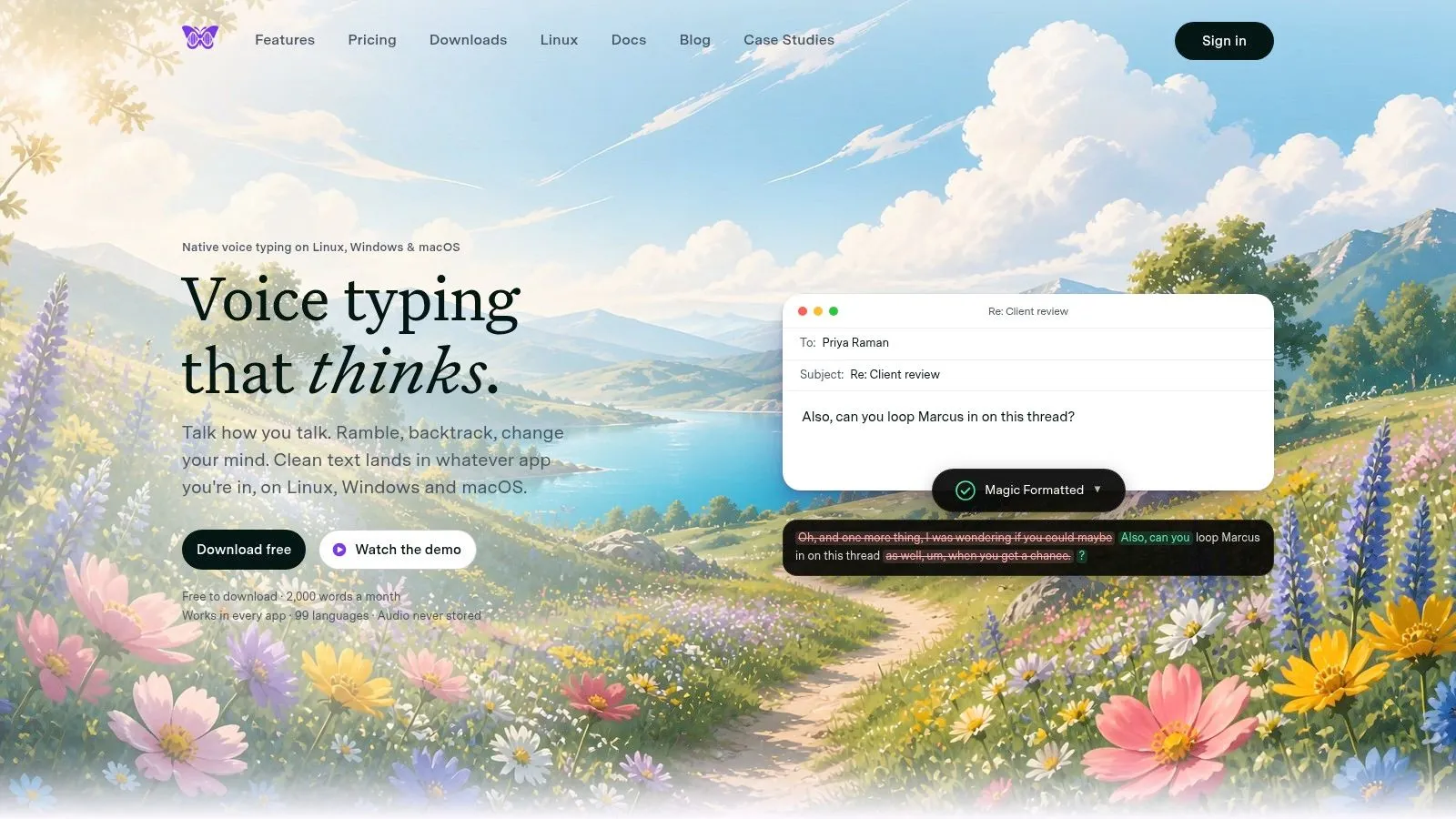
Vibe Typer is for people who want dictation to behave like a system-wide input method rather than a separate transcription window. It runs on Linux under both Wayland and X11, on Windows, on macOS, and on iOS, and it inserts text into whichever app holds the cursor. So it works in terminals, code editors, chat windows, email clients, and document apps without a plugin for each one.
Its most distinctive feature is Magic Formatter. It removes filler, applies the corrections you made out loud, fixes punctuation, and follows custom style instructions, while leaving names, numbers, and dates alone. A diff view shows the spoken transcript next to the final text, so you can see what the AI changed and whether a formatting instruction helped or broke something.
Where Vibe Typer fits best
Privacy is part of the design. Vibe Typer says audio is processed in memory, transcripts aren't kept on its servers, and neither audio nor text is used for training. That is a different model from tools that send recordings to third-party servers and keep them, a concern raised in PMC privacy research on dictation software and offline alternatives.
The app supports 99 languages with optional automatic detection, plus a custom dictionary for names, jargon, and product terms. It also has hold-to-talk and toggle recording, configurable hotkeys, automatic system mute, AI commands such as rewrite and reply, synced preferences, and private on-device history. The Free tier is 2,000 words and 20 AI operations a month. Pro is $8 a month billed annually, which is $96 a year, or $10 month to month. Pricing is on the Vibe Typer website.
Practical rule: if your work crosses Linux, Windows, and macOS, test insertion in your terminal and editor, not only in a document. Cross-platform support matters less if the text lands in the wrong place.
The trade-offs are plain. Heavy users may outgrow the Free limits, mobile is iOS only, and there is no server-side transcript backup or shared cloud history, because of the privacy model. What you get is app-aware insertion, a visible diff, wide language coverage, and privacy controls in one tool. That matters most to Linux users, developers, and teams buying seat-based business plans. See this real-time dictation software comparison for another view.
2. Nuance Dragon Professional v16
Dragon Professional v16 is for a different buyer. It's a Windows-only, locally installed dictation suite for people who spend most of the day writing documents, email, case notes, or content inside established desktop software. Its strength is depth on a Windows workstation, not operating system coverage.
Dragon has custom voice commands, user vocabularies, punctuation controls, and editing commands. It integrates with Microsoft Word and Outlook, so it fits people whose work already lives there. It is built for Windows 11 and runs offline after installation, which is a real privacy and connectivity advantage over cloud tools.
A specialist choice for desktop dictation
The main trade-off is setup. Dragon rewards people who dictate all day and are willing to configure vocabulary, microphones, and commands. It's a poor fit if you switch between Linux, macOS, phones, and browser apps.
Speed matters alongside accuracy, and speech model benchmarks show why. In Whisper speed and accuracy benchmarks, a medium model with 769 million parameters reached 94.2% conversational accuracy at real-time factors of 0.80x on an M1 Pro and 0.38x on an M2 Max. The large-v3 model reached 96.0% but ran at 2.5x and 1.05x on the same machines. The lesson applies to Dragon too. A small accuracy gain may not be worth slower interaction for everyday dictation.
Dragon Professional's advantages are mature command-and-control, local processing, and deep Windows app integration. Its disadvantages are Windows-only coverage, a high upfront cost, and sensitivity to microphone quality and background noise. Choose it when Windows is the center of your work and command depth matters more than portability.
For product details, visit Nuance Dragon Professional.
3. Nuance Dragon Medical One
Dragon Medical One is built around clinical documentation rather than general writing. It has medical vocabularies, clinician commands, roaming user profiles, and integration with Windows-based electronic health record systems. A clinician who moves between supported workstations gets the same profile on each one instead of rebuilding preferences.
That convenience comes from its cloud architecture. Central management, frequent updates, and profile roaming all depend on it, which means an internet connection is required. Healthcare organizations still have to run their own governance, security, procurement, and implementation review. A clinical vocabulary on its own doesn't satisfy every policy.
Clinical workflow over general dictation
PowerMic Mobile turns a phone into a wireless microphone, which is useful when clinicians want a familiar handheld device while dictating into a Windows clinical application. The product is also sold for organizational deployment, where administrators need consistent configuration and management.
"Medical dictation" describes a use case, not a compliance conclusion. Confirm the vendor's current contract terms, deployment model, retention behavior, and your own organization's requirements before adopting it. For a separate take on choosing tools for clinical documentation, see this guide to medical dictation software.
Dragon Medical One's strengths are its medical vocabulary, clinician commands, roaming profiles, and enterprise management. Its drawbacks are a subscription model, separate implementation fees, Windows-centric operation, and the dependence on connectivity. It is the most specialized product in this roundup. It makes sense for healthcare organizations that need those clinical features, and not for someone who wants cross-platform dictation for terminals, personal notes, and browser work.
Explore the product through Nuance Dragon Medical One.
4. Windows Voice Typing
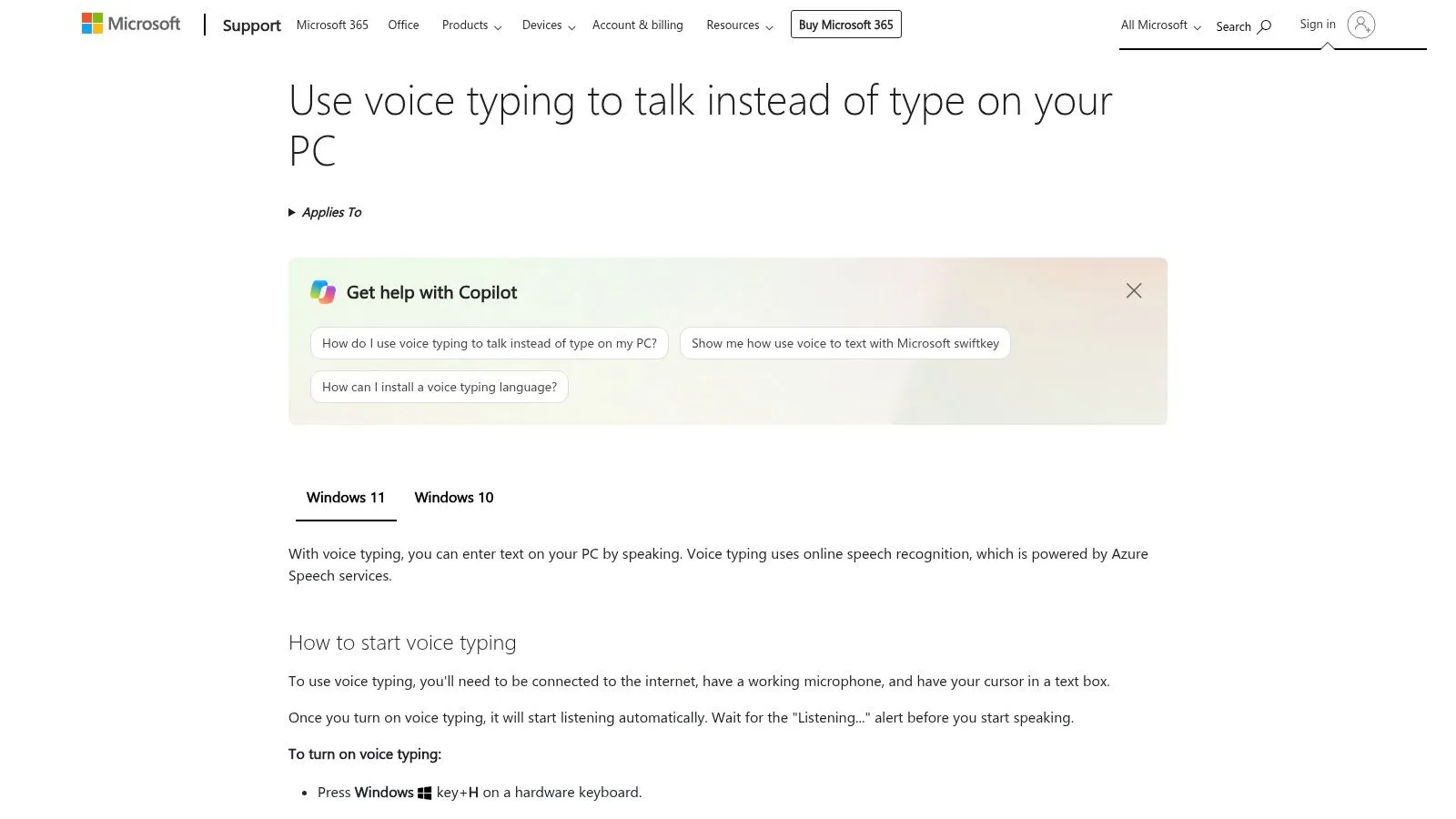
Windows Voice Typing is the baseline if you want nothing to install. On Windows 10 and 11, pressing Windows key + H opens dictation wherever there is a text cursor: documents, messages, browser fields, and so on. Microsoft documents the feature and how to turn it on in its Windows Voice Typing support pages.
The appeal is convenience. There's no separate app to deploy, no setup, and no subscription decision. You can turn auto-punctuation on or off and use basic commands for editing, cursor movement, and deletion. For occasional messages or short drafts, that may be enough.
The practical ceiling
The limits show up once your needs get specific. Windows Voice Typing has fewer customization and command features than a professional dictation suite, and narrower language support than products built around custom vocabularies or broad multilingual coverage. It's also Windows-only, so it won't follow you to a Mac, a Linux desktop, or an iPhone.
That makes it a useful control in any comparison. If a third-party app claims to make you faster, compare it against the built-in feature in the apps you already use first. Windows Voice Typing can transcribe speech. The question is whether you need custom terms, advanced commands, formatting cleanup, cross-platform preferences, or a particular privacy model.
Windows Voice Typing is a convenient starting point, not an automatic replacement for a dedicated dictation tool.
Choose it for light Windows dictation with nothing to deploy. Look elsewhere for heavy daily use, technical vocabulary, advanced formatting, or work that moves across operating systems. This overview of dictation software for Windows compares the Windows-focused options in more depth.
5. Apple Dictation
Apple Dictation is the obvious choice for people who only use Apple devices. It works across macOS, iOS, and iPadOS, so you can dictate into system text fields without installing anything. Apple covers setup and features in its Mac Dictation guide.
On Apple silicon Macs, general dictation can be processed on-device, which matters if you want built-in input that works offline and keeps audio local. Apple silicon devices also let you type while dictating, which is handy for correcting or adding to dictated text without stopping the session.
Best for people on Apple devices
Apple Dictation's language list is broad, but availability varies by region and device model. Check the settings on the actual Mac, iPhone, or iPad rather than a general feature list. If you need a specific language, dialect, or specialized vocabulary, verify it's available before relying on it.
The trade-off is customization. Apple Dictation is tightly integrated and easy to toggle, but it doesn't have the command systems, custom dictionaries, formatter controls, or cross-platform reach of dedicated products. It also does nothing for you on Linux or Windows.
For casual notes, messages, emails, and everyday text entry across Apple devices, nothing to install and tight platform integration are strong arguments. For technical writing, repeated corrections, or teams spread across several operating systems, a third-party tool gives you more control. The question is whether Apple's built-in layer already covers the places where you write.
Read more about voice to text for Mac before deciding whether built-in dictation is enough.
6. Talon Voice
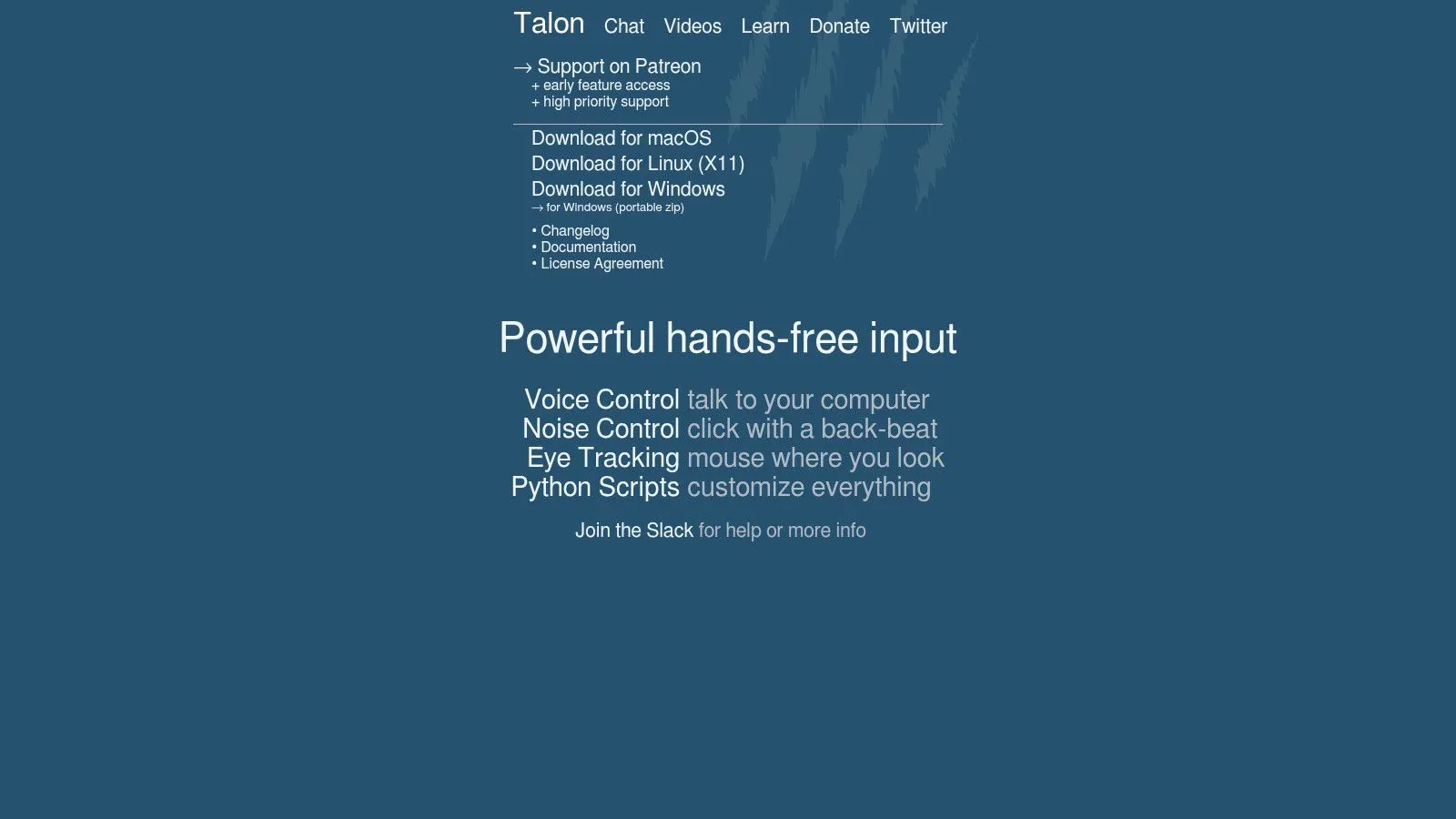
Talon Voice is for people who want to control a computer by speech, not only put words into a text field. It gives you voice control of the cursor, keyboard, and mouse on Windows, macOS, and Linux, with Python scripting and configurable command grammars. Optional eye tracking and community command packs extend it further for hands-free use.
Developers are a natural fit because Talon handles coding and terminal work, where ordinary dictation struggles with commands, symbols, navigation, and repeated actions. Its Linux support also makes it an option for people who need more than a browser microphone button or the platform's built-in dictation.
Control depth comes with configuration
Talon's main advantage is programmability. You can shape commands around your own apps and habits, which is valuable for hands-free coding and for people managing repetitive strain injuries. The community contributes documentation and command packs, and an optional Patreon supports the project.
The cost is a steep learning curve. Talon needs more setup than a simple voice typing app, and advanced features may depend on external speech engines and more configuration. That's not a flaw for power users, but it changes the question. Talon is a voice control environment that includes dictation, not an install-and-speak utility.
Talon makes sense when the goal is to operate software by voice. Choose a simpler tool when you only need spoken text inserted into ordinary fields.
It fits developers, accessibility-focused users, and technical people willing to customize their environment. It's a poor fit for someone who wants polished prose with no configuration. Visit Talon Voice to look at its scripting and platform model.
7. Voice In Voice Typing
Voice In is a browser-first option for people whose work happens inside web apps. The Chrome and Edge extension adds dictation to text fields on 10,000+ websites and web apps, including Gmail, Slack, Zendesk, Salesforce, and electronic medical record systems, according to the Voice In application directory. Its cross-platform reach comes from the browser, not from native desktop integration.
That distinction decides its value. A team that works mainly in SaaS tools can roll out a browser extension without installing a native dictation client on every operating system. Voice commands cover punctuation and editing, and custom commands, snippets, and Advanced Mode in the Plus tier give frequent users more control.
Strong inside the browser, limited outside it
Voice In's browser scope is also its boundary. It doesn't work in native desktop apps, terminals, or code editors unless those run inside a supported browser. It relies on browser speech APIs, and some advanced features need a Plus subscription.
For browser-first teams, this can be a better fit than a desktop app because the deployment matches the work. A support team in Zendesk, a sales team in Salesforce, or a distributed team on browser-based email and chat can prioritize consistent web access over native insertion.
For mixed setups, test the places where browser and desktop work meet. If people move from a web CRM to a native document editor all day, Voice In covers only part of it. If nearly every text field is in Chrome or Edge, its light install is a real advantage.
7-way voice typing apps comparison
| Product | Implementation complexity | Resource requirements | Expected outcomes | Ideal use cases | Key advantages |
|---|---|---|---|---|---|
| Vibe Typer | Low to moderate, native installers, quick hotkeys; formatter tuning optional | Modest, desktop app, in-memory processing, cross-platform (Linux/Win/macOS) | Cleaned text inserted into any app in real time | Developers, Linux users, terminal work, teams needing seat licensing | Magic Formatter with diff, native Wayland/X11 support, no server-side transcript storage, free tier |
| Nuance Dragon Professional v16 | Moderate, install, initial training and customization on Windows | High, Windows desktop, good mic, local CPU resources | Very high continuous-dictation accuracy; mature command and editing controls | Legal, enterprise, heavy daily dictation and document work | Offline local processing, deep Word/Outlook integration, custom commands |
| Nuance Dragon Medical One | Moderate to high, enterprise deployment and cloud integration | High, cloud subscription, Windows EHR clients, centralized infra | High clinical accuracy; centralized management and roaming profiles | Hospitals, clinicians, EHR-integrated documentation | Medical vocabularies, centralized deployment, PowerMic Mobile support |
| Windows Voice Typing | Very low, built-in, no install (Win key + H) | Minimal, Windows 10/11; basic microphone; may use cloud services | Moderate accuracy for casual use; limited customization and languages | Casual Windows users and occasional dictation | Free, nothing to deploy, available system-wide |
| Apple Dictation | Very low, built into macOS/iOS, easy to enable | Minimal, Apple device; on-device (Apple silicon) for offline privacy | Moderate to good accuracy; privacy benefits when on-device | Apple users who want integrated, private dictation | On-device processing on supported Macs, tight OS integration, free |
| Talon Voice | High, steep learning curve, scripting and configuration required | Variable, cross-platform clients; may need external speech engines | High for power users; full hands-free control and coding | Developers, RSI users, advanced hands-free coding and automation | Python scripting, configurable command grammars, Linux support |
| Voice In (Chrome/Edge extension) | Low, simple extension install and basic config | Low, browser-based, relies on browser speech APIs; works cross-platform via browser | Good within web apps; consistent dictation across many SaaS sites | Teams mainly using web apps (Gmail, Slack, CRMs, EMRs) | Quick rollout as an extension, broad web app coverage, cross-platform via browser |
Choose by workflow, not transcription accuracy alone
The right voice typing app depends on where the text has to go, how much control you need after transcription, and what happens to the audio along the way. The category is growing fast. Kaiso Research valued the global automatic speech recognition apps market at USD 3.03 billion in 2025 and projects USD 14.32 billion by 2035, a 16.8% CAGR from 2026 to 2035. That growth suggests voice input is becoming an ordinary way to type, but it doesn't mean every product serves the same user.
Choose Vibe Typer when you need native Linux coverage on Wayland and X11, app-aware insertion, 99 languages, in-memory processing, a visible diff of formatter changes, and preferences that follow you across platforms. Its main differentiator is system-wide insertion combined with visible AI cleanup. The lack of server-side transcript storage matters more than a generic "private" label when your work contains sensitive material.
Choose Dragon Professional for Windows-only offline dictation, deep commands, and established Word or Outlook work. Choose Dragon Medical One when the clinical vocabularies, roaming profiles, PowerMic Mobile, and centralized management match your organization's clinical environment. Don't treat either product's specialization as a reason to use it everywhere.
For built-in convenience, start with Windows Voice Typing or Apple Dictation. Choose Talon Voice when hands-free computer control, coding, terminal work, or custom grammars matter more than quick setup. Choose Voice In when your team works mostly in browser apps and doesn't need dictation in native desktop software.
Before committing, dictate the same short passage into your most important destinations. Include proper names, numbers, punctuation, a mid-sentence correction, a technical term, and text that has to land in an app-specific field. Check which languages are available, whether audio leaves the device, how transcripts are retained, and how much configuration your team can support. That test tells you more than any accuracy claim, in the same way that the business case for great service rests on the whole customer experience rather than one interaction.
Vibe Typer combines AI-cleaned dictation, app-aware text insertion, a Magic Formatter diff, support for Linux, Windows, macOS, and iOS, and 99 languages. Visit Vibe Typer to test whether its privacy model and cross-platform support fit the places you write.
Try Vibe Typer free
Voice typing that works in every app on Linux, Windows, and macOS. Free to download: 2,000 words a month, no card.
Download free