Linux Voice Recognition: A Practical Guide for 2026


You're in a terminal on Sway or GNOME, your microphone is working, and the speech recognizer clearly understands what you said. Then the cursor jumps, the text appears in another window, or nothing arrives at all. A dictation demo can look perfect while daily Linux voice recognition still fails at the one moment that matters, when recognized words must land in the field you're using.
Speech-to-text runs on Linux. The harder question is whether the complete path, from microphone capture through model decoding to text insertion, works reliably across Wayland compositors, terminals, code editors, and ordinary desktop applications.
Table of contents
- Why Linux voice recognition still feels different
- How speech-to-text actually works on Linux
- The Wayland, X11, terminal, and editor problem
- Open source, cloud, and hybrid engines compared
- Local versus cloud and the real privacy tradeoff
- Setup and best practices for reliable Linux dictation
- Where Vibe Typer fits into your Linux workflow
- Decision checklist and frequently asked questions
Why Linux voice recognition still feels different
A developer dictating a commit message into a terminal exposes the problem quickly. On Sway, the recognizer may produce an accurate sentence, yet the terminal receives only part of it, receives it through a clipboard fallback, or sees input after the prompt has already changed. GNOME, KDE Plasma, Sway, and Hyprland don't all provide the same route for an external application to commit text into the focused field.
That's unlike the experience many users expect from macOS or Windows, where system accessibility and dictation frameworks provide a more clearly defined operating-system insertion path. Linux has historically offered several independent layers instead of one dominant voice-typing API. IBM announced in April 1999 that ViaVoice was the first commercial speech-recognition technology ported to Linux, and IBM later made a Linux version available at no charge before the developer removed the free software development kit in 2002. The history also includes projects such as Mycroft and a long series of free, open-source, and proprietary experiments, rather than one universally adopted product. IBM's Linux ViaVoice announcement records that early port.
Recognition is only half the job
The desktop itself adds several problems:
- Compositors. GNOME Mutter, KDE KWin, Sway, and Hyprland expose different capabilities and configuration expectations.
- Wayland's security model. X11 allowed broad key simulation and selection access. Wayland puts input delivery behind compositor-mediated protocols and permissions.
- Targets. A GTK text field, a Qt editor, a browser control, a terminal emulator, and a TUI editor don't necessarily accept committed text in the same way.
Most coverage of Linux voice recognition stops at "does it work on Wayland?" The more useful question is how consistently text lands in the intended application across modern desktops. The Sight AI voice search insights make a similar point: judge a voice interface on the whole path from speech to result, not on recognition alone.
A setup that works in a browser may fail in a terminal. An X11 helper may appear functional under XWayland and then fail in a native Wayland application. Reliable dictation therefore requires coordinated choices about the audio stack, recognition engine, display server, insertion method, and target application.
Practical rule: Test the exact workflow you use every day, not just a sample sentence in a text box.
How speech-to-text actually works on Linux
Dictation has four stages. The first captures audio, the second cleans it, the third turns the sounds into words, and the fourth writes the result into the active document. If the final text is wrong or late, the failure may have happened before recognition ever began.
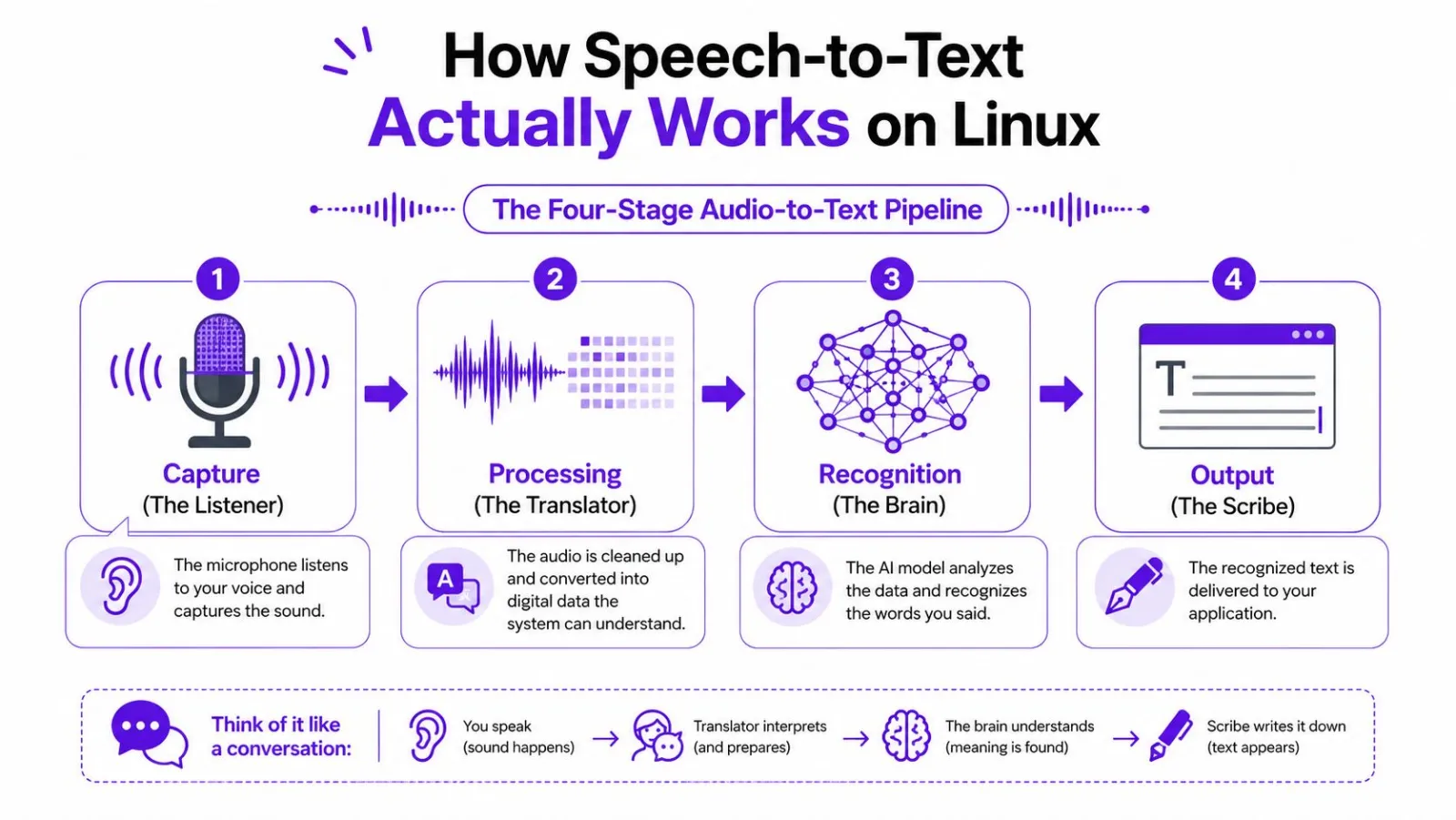
The four stages
Capture starts with the microphone. Linux audio typically travels through PipeWire's graph, PulseAudio compatibility services, or ALSA at the hardware boundary. PortAudio is another common capture interface used by applications across languages. This stage fails when the wrong source is selected, another application holds exclusive access, or the audio graph routes silence.
Pre-processing makes speech easier to interpret. Noise suppression can reduce steady background sound, voice activity detection can identify when speech begins and ends, and optional echo cancellation can limit feedback from speakers. WebRTC VAD and RNNoise are familiar building blocks for these tasks, although adding processing can also introduce delay or distort quiet consonants.
Feature extraction converts the waveform into a representation the model can use, commonly a spectrogram or mel-frequency representation. The recognizer doesn't read raw microphone samples as a human would. It evaluates patterns that correlate with speech sounds, transitions, rhythm, and likely phonetic content.
Decoding turns those patterns into words. An acoustic model maps sound to likely phonemes, a language model constrains plausible word sequences, and beam search evaluates competing possibilities before emitting text. Vosk and Whisper are the two common local decoder families, while cloud engines send captured audio to remote services over HTTPS.
Where delay appears
Latency can enter at every handoff. PipeWire may buffer audio, voice activity detection may wait for an endpoint, a larger model may need more CPU or GPU time, and the insertion layer may deliver text in chunks instead of one committed string. Network-based decoding adds another dependency because transcription cannot finish until audio reaches the service and the response returns.
That's why a model that recognizes speech accurately in a recorded file may feel poor for live dictation. Daily use needs clear capture, sensible endpointing, responsive decoding, and insertion that preserves the target application's input state.
The Wayland, X11, terminal, and editor problem
The visible failure in Linux voice recognition usually happens after the model has finished. X11 made naive insertion comparatively easy because an external client could synthesize keystrokes through mechanisms such as XTest and interact with the focused window. That approach was broad and sometimes unsafe, but many tools could inject text and hope the focus remained stable.
Wayland intentionally narrows that freedom. Text entry is mediated by the compositor and associated protocols, including zwp_input_method-v2 and text-input-unstable-v3. The Wayland text-input protocol describes text-entry state and compositor-delivered text, not a universal permission for arbitrary key simulation. The input-method architecture separates the application, compositor, and input method, as described in the Wayland input-method architecture.
One phrase, several insertion paths
A dictation application may need to speak the native text-input protocol, use a compositor-supported virtual keyboard route, operate through an XWayland environment with limitations, or use a portal and clipboard-based fallback. Each route behaves differently depending on the compositor and application.
| Target | X11 method | Wayland native method | Common failure |
|---|---|---|---|
| GTK or Qt text field | XTest keystrokes or clipboard paste | Text-input or input-method commit | Focus changes or unsupported protocol |
| Browser text area | Synthetic key events or paste | Compositor-mediated text delivery | Text lands after the page changes focus |
| Terminal emulator | Byte-oriented key stream | Native input route or paste fallback | Bracketed paste, chunking, or prompt interaction |
| Code editor | Keystrokes, selection, or paste | Text-input commit with editor-specific behavior | UTF-8 or composition boundaries are mishandled |
| TUI editor | Terminal input stream | Terminal-mediated delivery | Escape sequences and editor modes conflict |
Terminals are especially unforgiving. They consume a stream of bytes, so a recognizer that inserts text slowly can interleave with a prompt, an editor shortcut, or a key you pressed while speaking. Neovim in a TUI, VS Code, and native GTK or Qt editors have richer input handling, but they still expect valid UTF-8 and coherent commit semantics.
So insertion has to account for the target application as well as the desktop. For a deeper look at these paths, see voice typing on Wayland and Linux.
Open source, cloud, and hybrid engines compared
Engine selection works best when you judge every option against the same four questions. How accurate is it for natural dictation? How responsive does it feel? Can it operate offline? What setup burden does it create?
Vosk remains attractive when a lightweight, local pipeline matters more than maximum transcription quality. Its largest publicly documented English model is 1.8 GB, with reported word error rates of 5.69% on LibriSpeech test-clean, 6.05% on TED-LIUM, and 29.78% on CallCenter. Those results show why clean office speech and conversational telephone audio shouldn't be treated as equivalent workloads. Vosk's model documentation provides the model and evaluation details.
Whisper-style local implementations, including whisper.cpp, are more accurate and punctuate better, especially with accents, technical vocabulary, or natural phrasing. The tradeoff is model size, memory use, runtime requirements, and a more involved install. This Linux speech-recognition comparison puts offline Whisper implementations at the top of the local options for accuracy, with Vosk-based tools lighter and easier to run on modest hardware.
| Engine | Type | Accuracy for natural dictation | Latency | Offline | Setup cost |
|---|---|---|---|---|---|
| Vosk | Open source, local | Good in suitable audio and domains, weaker in difficult conversational speech | Responsive on modest hardware | Yes | Low to moderate |
| Whisper.cpp | Open source, local | Strong, with better punctuation and accent handling | Depends heavily on model and hardware | Yes | Moderate |
| Cloud Whisper APIs | Hosted decoder | Strong, subject to service behavior and audio quality | Network-dependent | No | Low code setup, ongoing service dependency |
| Google STT | Hosted decoder | Strong for supported speech and languages | Network-dependent | No | Low user setup, provider dependency |
| Azure Speech | Hosted decoder | Strong with enterprise controls and configuration | Network-dependent | No | Moderate service configuration |
| Hybrid pipeline | Local VAD plus cloud decoding | Can combine responsive endpointing with strong remote decoding | Network and service-dependent | Partly | Moderate |
Cloud engines remove local model management, but they introduce network dependence, account configuration, and data-governance questions. A hybrid design can keep capture and endpointing local while sending finalized segments to a remote decoder. That can feel smoother than streaming every raw audio frame, but it still isn't offline.
The right match depends on the work. Short email dictation may tolerate a remote engine. Long-form writing benefits from punctuation and accent accuracy. Code comments require accurate technical vocabulary, while commands are often better typed directly unless they're long and structured.
Local versus cloud and the real privacy tradeoff
"Local" and "cloud" aren't complete privacy categories. The useful questions are who can see the audio, how long it exists, and who carries responsibility if the handling policy doesn't match the sensitivity of the speech.
A developer dictating a commit message may choose on-device whisper.cpp so source-related context never leaves the workstation. A journalist transcribing interviews may prefer local processing because raw recordings and spoken identities carry obvious sensitivity. A sysadmin taking incident notes might use a hybrid route for convenience, but should understand that finalized segments and their surrounding context cross the selected service boundary.
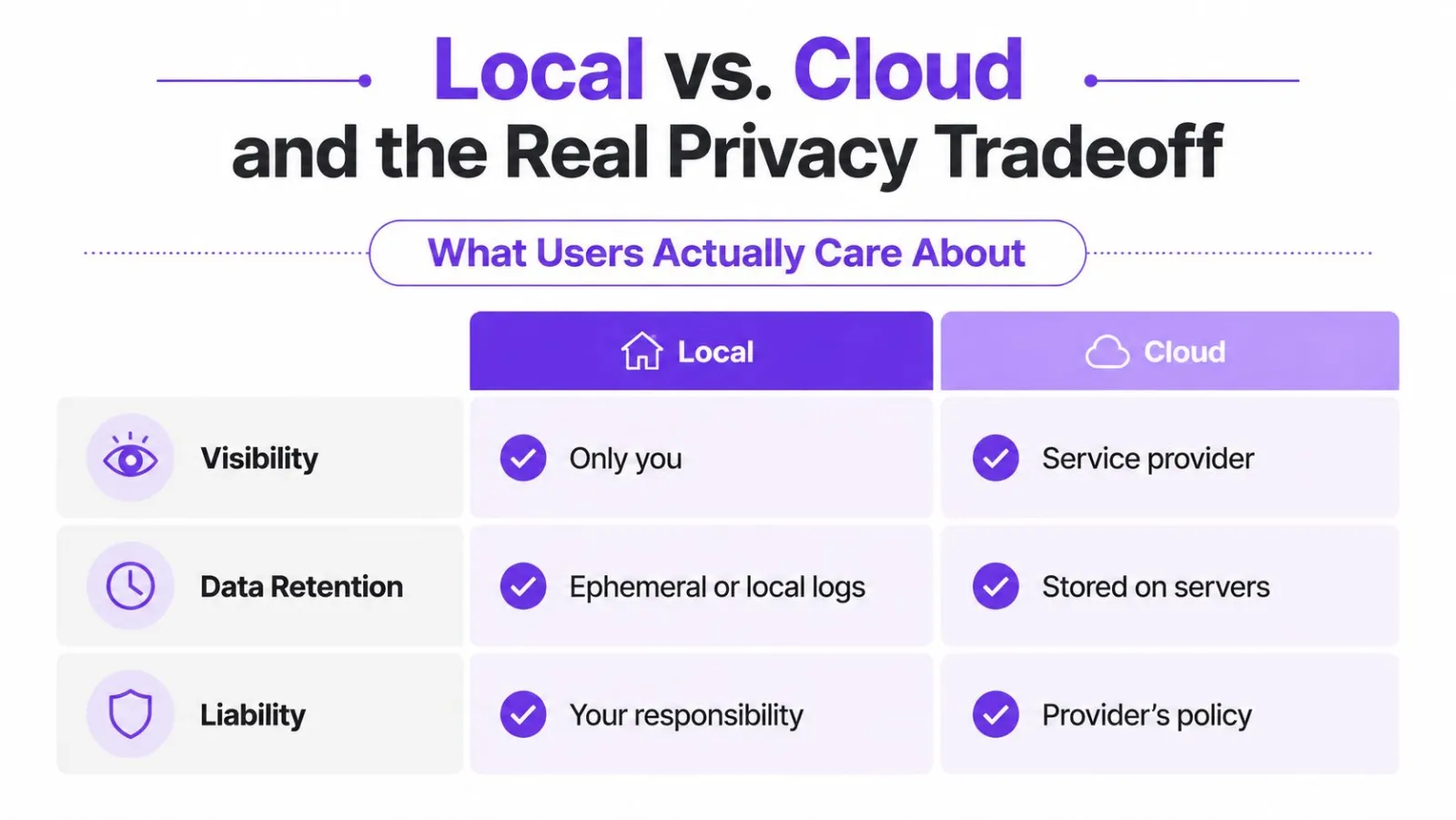
What in-memory processing means
In-memory processing means audio is buffered in volatile RAM, passed to the transcription pipeline, and discarded after transcription. A careful implementation also avoids writing debug recordings or temporary transcripts to disk. That's different from an application that caches audio, keeps local logs, or retains transcripts for quality improvement.
Local processing still doesn't make the whole workstation private. A compromised X11 session, malicious desktop file, unsafe extension, or captured clipboard can expose text after recognition. Cloud processing isn't automatically careless either, provided the service contract, retention controls, access policy, and any zero-retention mode match the user's requirements.
The decision rule is direct:
- Sensitive speech. Keep recognition local when practical, and inspect local logs, history, and clipboard behavior.
- Convenience-first speech. Use a cloud service when its retention and contractual terms are acceptable.
- Mixed workloads. Route ordinary dictation one way and confidential material another way.
For product-level details about local history handling, review Vibe Typer's local history and privacy documentation. The important point is to choose the boundary that matches the words you're saying, not the label attached to the engine.
Setup and best practices for reliable Linux dictation
Reliable dictation starts with audio, not model downloads. In PipeWire or PulseAudio, inspect the selected source and confirm that the application is receiving the microphone you intend to use. Dual-input laptops often expose an internal microphone and a headset microphone, and a generic "default" source may not select the one closest to your mouth.
Build the path in the right order
- Verify the capture source. Speak at a normal distance and watch the input level. A silent or clipped waveform will defeat every decoder.
- Avoid unnecessary exclusive access. Shared access is usually more practical when a browser, meeting application, and dictation tool need the microphone during the same session.
- Choose the insertion backend for the compositor.
wtypeanddotooldon't behave identically under Sway, GNOME, and KDE Wayland. X11-only helpers such asxdotoolcan fail in a Wayland session. - Use push-to-talk. A hold-to-talk or toggle shortcut reduces accidental capture and avoids always-on listening. Pick a binding that doesn't collide with common editor commands or terminal shortcuts.
- Add your vocabulary. Add names, package terms, product language, and recurring jargon to a per-user dictionary or biasing layer where the engine supports it.
The audio graph and insertion route deserve separate tests. First confirm that a short recording is clean. Then test a paragraph in your main editor, a short phrase at a terminal prompt, and text in a browser or chat client. Don't assume success in one target transfers to another.
Field practice: Keep a fallback hotkey that changes engines or insertion modes. A crashed model process shouldn't end the workday.
Keep failures diagnosable
Monitor levels while troubleshooting, stop stale audio services or sockets when they block access, and check for conflicts with speech-dispatcher or another voice service. If text arrives in the wrong place, inspect focus and insertion permissions before replacing the recognition model. The recognizer may be correct while the compositor path is not.
Daily reliability comes from reducing moving parts. A smaller local model may feel better for quick notes, while a larger Whisper-style model may justify its resource cost for longer prose. Test both with your own microphone, accent, room, editor, and terminal instead of relying on a generic demo.
Where Vibe Typer fits into your Linux workflow
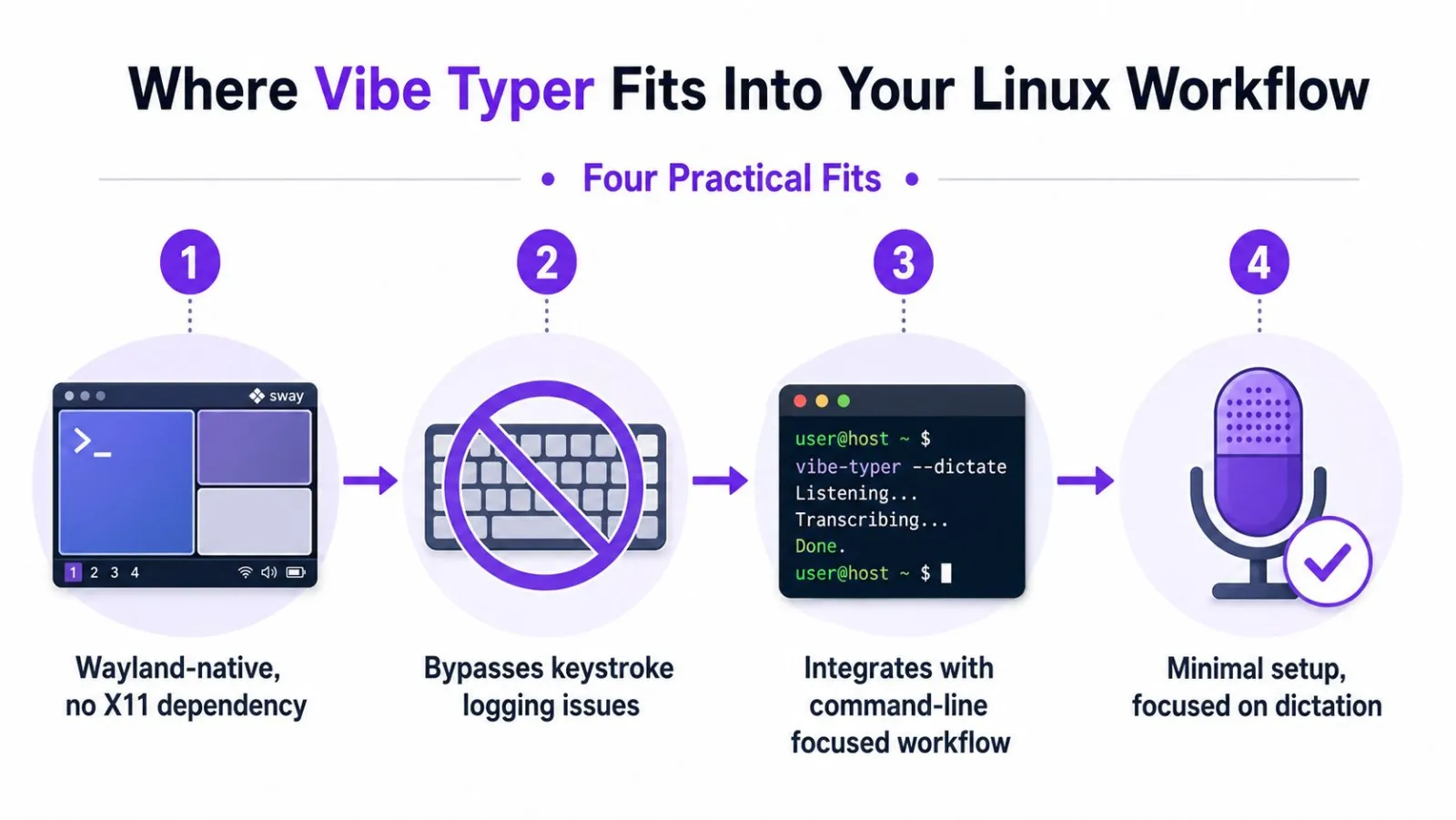
A Wayland-native dictation layer matters when the hard part is delivering the result to the right application rather than recognizing the speech. Vibe Typer is one option for that layer. It supports Linux on Wayland and X11, uses hotkey-based recording with hold-to-talk or toggle modes, and adapts text insertion per application, with plain-text handling for terminals and editors plus optional per-app overrides. The Vibe Typer features page has the details.
Four practical fits
A Sway or Hyprland user who has abandoned X11 keystroke injection needs compositor-aware delivery rather than another wrapper around xdotool. The hardest part of building it was handling different compositors across distributions, so the team wrote native helpers and tested on as many systems as it could. That addresses the integration layer, although the chosen speech model still determines recognition quality.
A developer moving between Vim, a REPL, and a code editor needs more than a clipboard window. Per-app insertion can reduce copy-and-paste detours and distinguish plain text delivery from editor-sensitive input. It won't make dense code ideal for speech, and it can't guarantee that every terminal behaves identically, so the exact workflow still needs testing.
A writer switching among Obsidian, a browser, and a terminal benefits from a global hotkey and text delivery that follows the active cursor. Magic Formatter can remove filler, apply corrections, adjust punctuation, and follow user-defined style instructions, while a diff view shows what changed. That cleanup layer is separate from the underlying speech model, so users should still evaluate transcription quality on their accent and vocabulary.
A privacy-conscious user should inspect the processing boundary rather than accept a broad privacy label. Vibe Typer's stated model uses in-memory audio processing, avoids server-side transcript storage, and doesn't train on user audio or text. Users should still review their own operating-system security, clipboard behavior, history settings, and any model or service configuration they enable.
Decision checklist and frequently asked questions
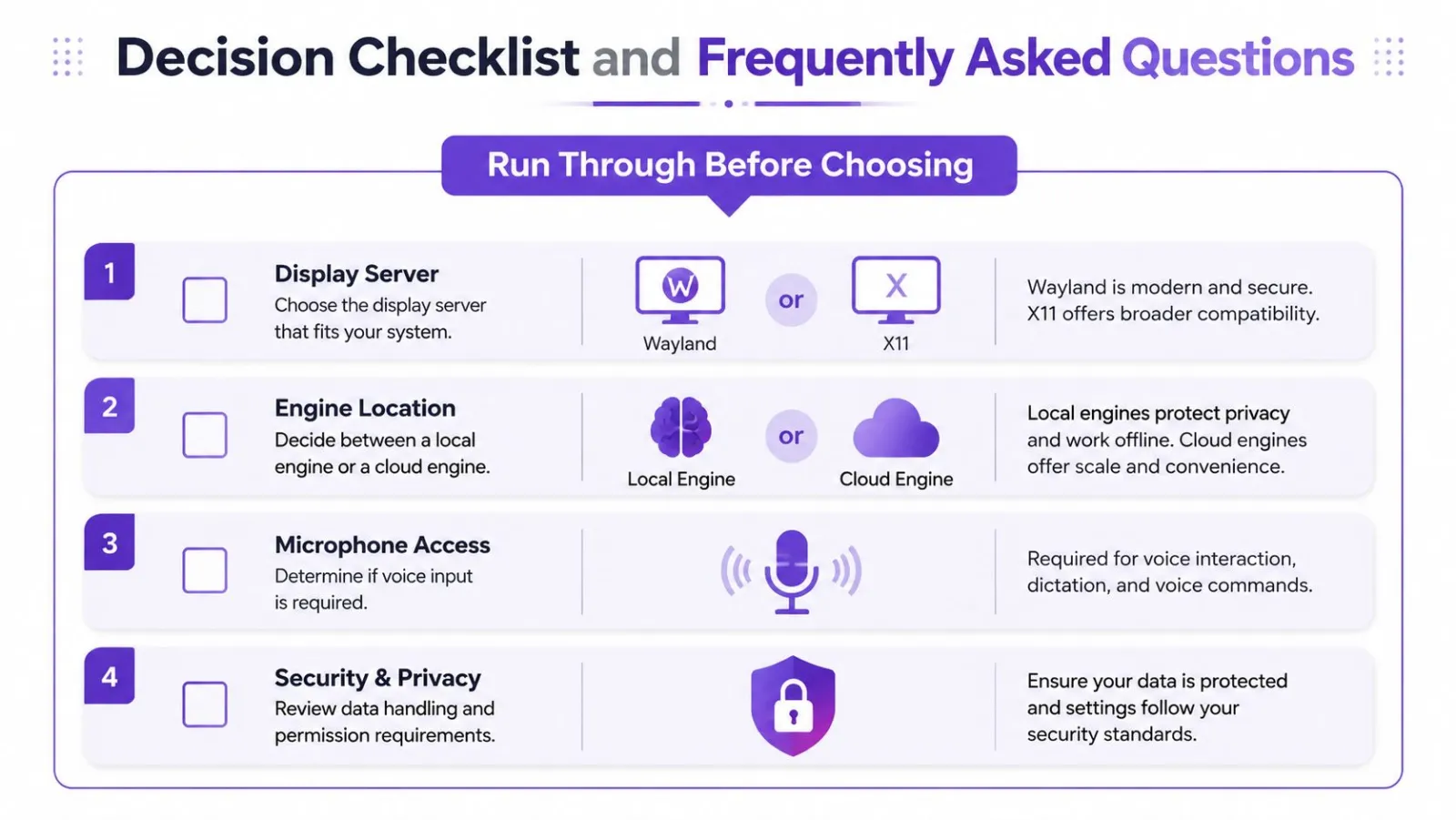
Run through these checks before committing to a Linux voice recognition setup:
- Display server. Confirm whether the session uses Wayland or X11, then verify the compositor and its supported insertion route.
- Engine class. Choose local Vosk or Whisper-style decoding for offline control, cloud decoding for managed infrastructure, or a hybrid design for mixed requirements.
- Audio path. Test the intended microphone through PipeWire, PulseAudio, or ALSA and confirm that levels remain clean during normal speech.
- Target applications. Dictate into the terminal, editor, browser, and chat application you use. Don't stop after testing a basic text field.
- Privacy boundary. Decide whether audio and transcript handling fit the sensitivity of your work, including local history, logs, clipboard data, and provider retention.
Frequently asked questions
Does speech-to-text work inside GNOME and KDE terminals?
It can, but terminal insertion depends on the compositor path, terminal emulator, focus state, and whether text arrives as committed input or a paste. Test the exact GNOME or KDE terminal you use rather than assuming editor behavior will carry over.
Are Sway and Hyprland supported?
Support depends on the tool's native Wayland integration and the protocols exposed by the compositor. X11-only utilities aren't reliable substitutes, so verify native support and test insertion in both a terminal and an editor.
How is accent tuning handled?
Use a model that handles accents well, keep the microphone placement consistent, and add recurring names and technical vocabulary to a custom dictionary when available. Whisper-style local implementations usually beat lighter Vosk setups on accuracy, but real results vary with audio and domain.
Does microphone hardware matter?
Yes. A stable, correctly selected microphone with clean levels gives the decoder better input than a distant or misrouted source. Audio routing problems often look like recognition problems.
What accuracy ceiling should I expect from open-source models?
There isn't one universal ceiling. Vosk's published results are strong on clean read speech and much weaker on conversational telephone audio, while Linux-focused comparisons place offline Whisper implementations at the higher-accuracy end of local options. Your room, accent, vocabulary, model size, and target workflow determine the result.
Vibe Typer runs on Linux (Wayland and X11), Windows, and macOS, with hotkey recording, per-app insertion, Magic Formatter, and in-memory audio processing with no server-side transcript retention. If your main frustration is getting recognized text into the correct terminal, editor, or desktop field, visit Vibe Typer and test it against the applications you use every day.
Try Vibe Typer free
Voice typing that works in every app on Linux, Windows, and macOS. Free to download: 2,000 words a month, no card.
Download free